Flashing: parapets, chimneys, valleys and penetrations
Flashing is sheet metal folded so that water runs where it should and not into the structure. It is done wherever a vertical surface meets a horizontal or sloping one: at a chimney, at a parapet, in a valley, along a drip edge and around penetrations.
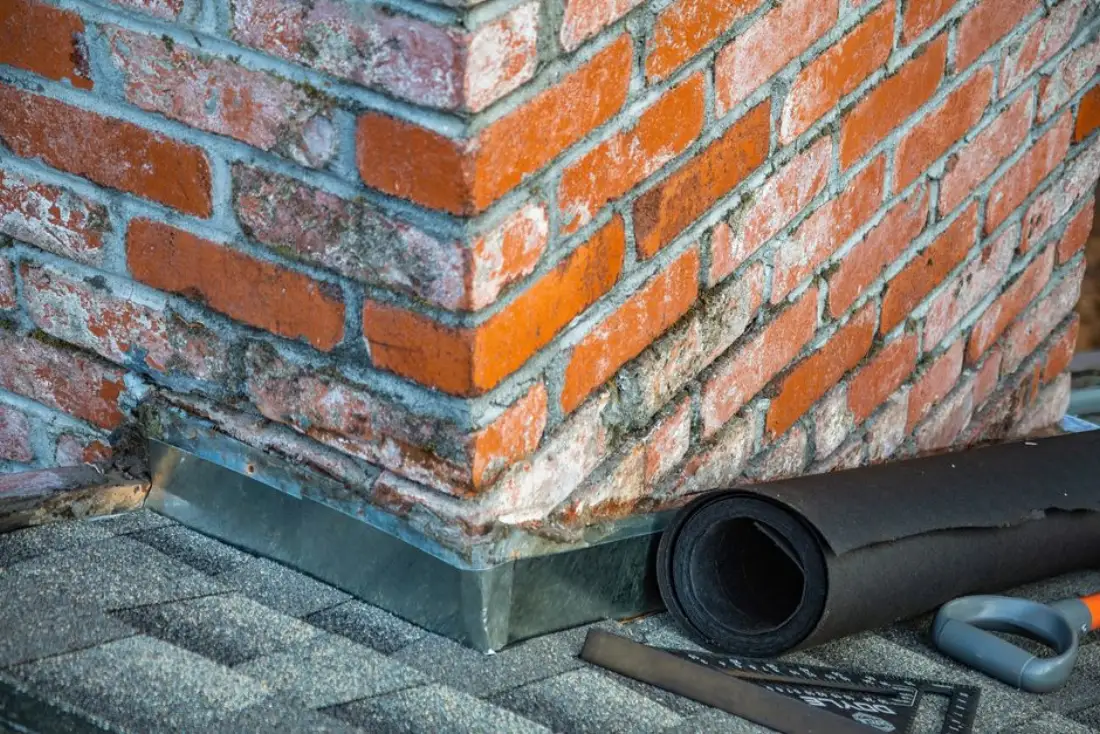
Chimney
A chimney is where leaks start most often. A vertical masonry structure passes through a surface that water runs down, and the metal has to throw it sideways. The lower part has to go under the covering, the upper part has to be cut into or anchored to the masonry and sealed, and above the chimney there is a point where the water divides. The usual fault is not a hole in the metal but a badly made top edge, where water gets in behind the flashing.
Parapet
A parapet is the low wall around a flat or mono-pitch structure. It gets a cover sheet on top, which must fall inwards and carry a drip edge so water does not run down the facade. On apartment buildings being insulated the parapet is raised, so the flashing is made again, often in a different developed width from the original.
Window sills
External sills are a subject of their own and have their own page: window sills. In short, a sill needs enough overhang and side upstands, or water runs along the reveal into the opening.
Valleys and drip edges
A valley is the channel where two surfaces meet at an angle. Water from both sides runs through it and it is the most heavily loaded point of the whole structure. The eaves edge carries the drip edge, which throws water into the gutter and keeps it from getting under the covering.
Penetrations and skylights
Every penetration, whether a small vent stack, a ventilation outlet, an aerial mast or a pipe, has to be flashed so that water runs around it. Around skylights the trim is made from prepared parts supplied by the window maker. This is exactly where improvising does not pay.
What the quote should name
The material, the developed width of each part, and how it meets the surrounding structure. A bare metre of sheet says nothing, because a drip edge folded from a narrow strip and a parapet cover sheet folded from a wide one differ fundamentally in both material and labour.
Frequently asked questions
Why does it leak at the chimney when the metal is intact?
Usually it is not a hole but the top edge of the flashing. If it is not let into the masonry or not sealed, water runs down the chimney and gets behind the metal. It then comes in at a point where the metal looks perfectly sound.
Why does a parapet cover sheet ripple over time?
Metal expands with heat and over a long run that change shows. A cover sheet screwed down solidly along its whole length has nowhere to grow, so it ripples and in time works its own joints loose. That is why movement joints are designed in from the start.
What is developed width and why does everyone keep mentioning it?
It is the width of the flat strip of sheet the part is folded from. The more folds a part has and the deeper it is, the wider the strip it needs. A quote without developed widths cannot be compared with another quote.
Describe the job
A few sentences and the location are enough. We read every enquiry and pass it to a sheet metal firm that works in your area. If we have nobody there, we tell you straight away.