Chimney and parapet flashing: where leaks start
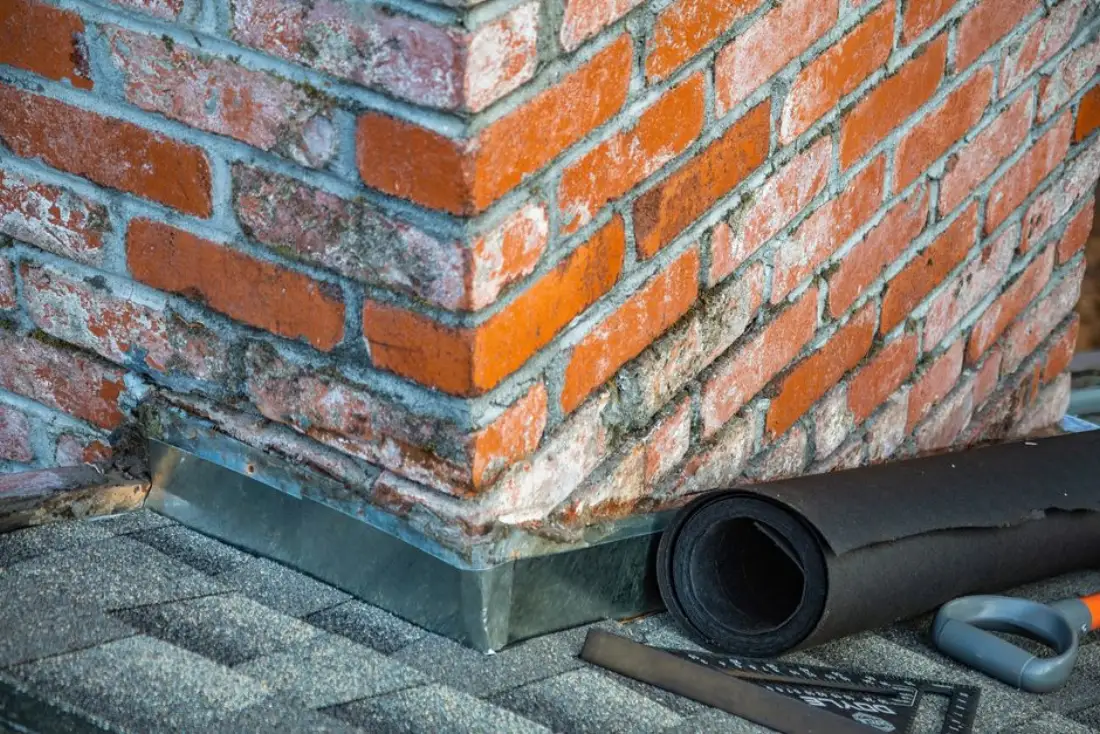
The two places where buildings leak most often have one thing in common: a vertical masonry structure passes through a surface that water runs down. The metal there is not meant to stop the water, it is meant to throw it sideways. That is the whole difference between a detail that works and one that does not.
A chimney: the problem is usually at the top, not the bottom
Chimney flashing has a lower and an upper part. The lower part goes under the covering, so water from the surface above the chimney runs over it and carries on. The upper edge has to terminate in the masonry of the chimney, normally cut into a joint or anchored with a trim and sealed. The usual fault is not a hole in the metal but exactly this upper edge. If it is not finished properly, water running down the chimney gets behind the metal and appears inside at a point where the metal looks undamaged.
The second critical point is above the chimney, where water has to divide to the sides. On wider chimneys a small saddle is made there. Without it, water, leaves and snow collect behind the chimney.
A parapet: the fall has to go inwards
A parapet is the low wall around a flat or mono-pitch surface. The cover sheet on top of it must fall inwards so water does not run down the outer facade, and must carry a drip edge on the outside so the remaining water drips off instead of running down the render. Because the parts are long, thermal expansion shows strongly on a parapet, so movement joints have to be designed in. A cover sheet screwed down solidly along its whole length ripples in summer and works its own joints loose over time.
What changes when a building is insulated
On an apartment building being insulated the parapet is raised by the thickness of the insulation. The old flashing no longer fits and new work is needed, usually in a different developed width. The same logic applies to window sills: insulation moves the facade outwards, and a sill that was fine before suddenly has too short an overhang and lets water into the reveal.
What the quote should name
For a chimney, how the upper edge is terminated. For a parapet, the fall, the drip edge and how movement is handled. And for both, the material and the developed width. A quote that says only chimney flashing
and a figure cannot be compared with another quote, because you do not know what is in it.
More on the Flashing page.